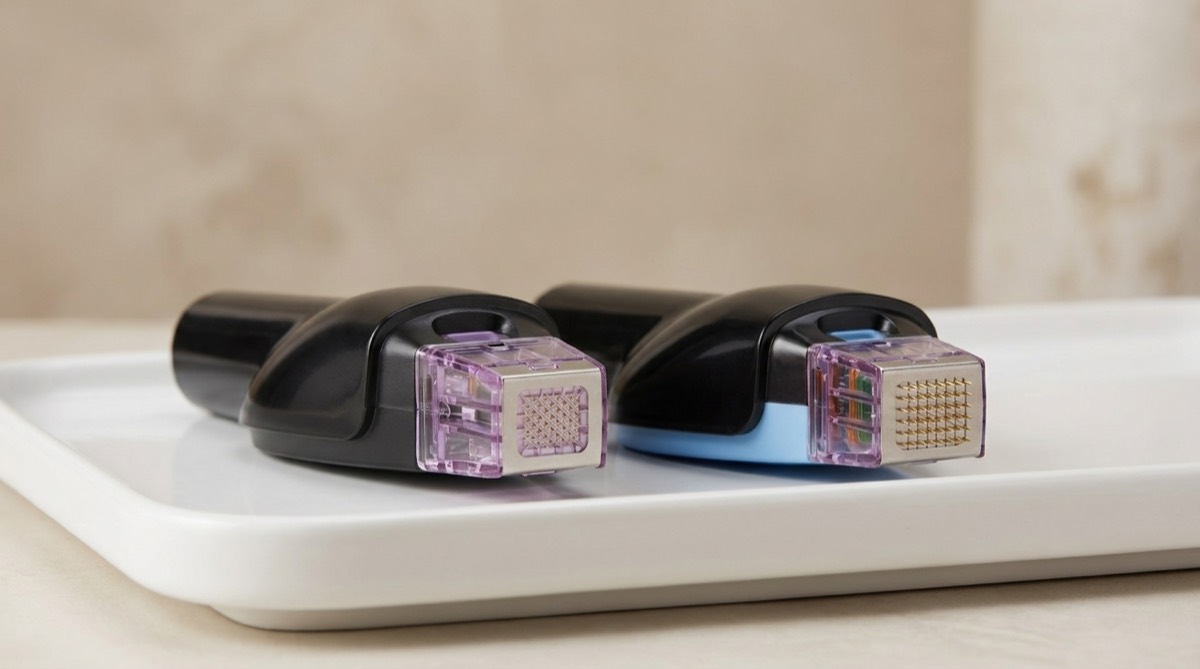
Different tips, different depths
The InMode Morpheus8 platform is built around a family of interchangeable treatment tips. Each tip is a sterile, single-use cartridge with a specific pin count, pin geometry, and maximum penetration depth. The provider selects the tip based on what is being treated, not based on preference.
On the face, the standard Morpheus8 tip uses a 24-pin or 40-pin configuration with a maximum depth of up to 4mm. That depth is calibrated for the thickness of facial dermis and the subdermal fat that sits beneath the cheek, jawline, and submentum. Pin diameter is thin to minimize trauma in cosmetically visible areas.
On the body, the dedicated Morpheus8 Body tip uses a larger pin array — typically 24 pins at a wider pitch — with a maximum depth of up to 8mm. The deeper penetration is necessary because body skin is thicker, the subdermal layer is denser, and the laxity targets are structurally further from the surface. The Burst configuration adds an additional staggered firing pattern useful for treating larger zones efficiently.
A provider who treats body areas with a face tip — or vice versa — is using the wrong tool. The pin geometry and depth control are not interchangeable, and the outcomes diverge accordingly.
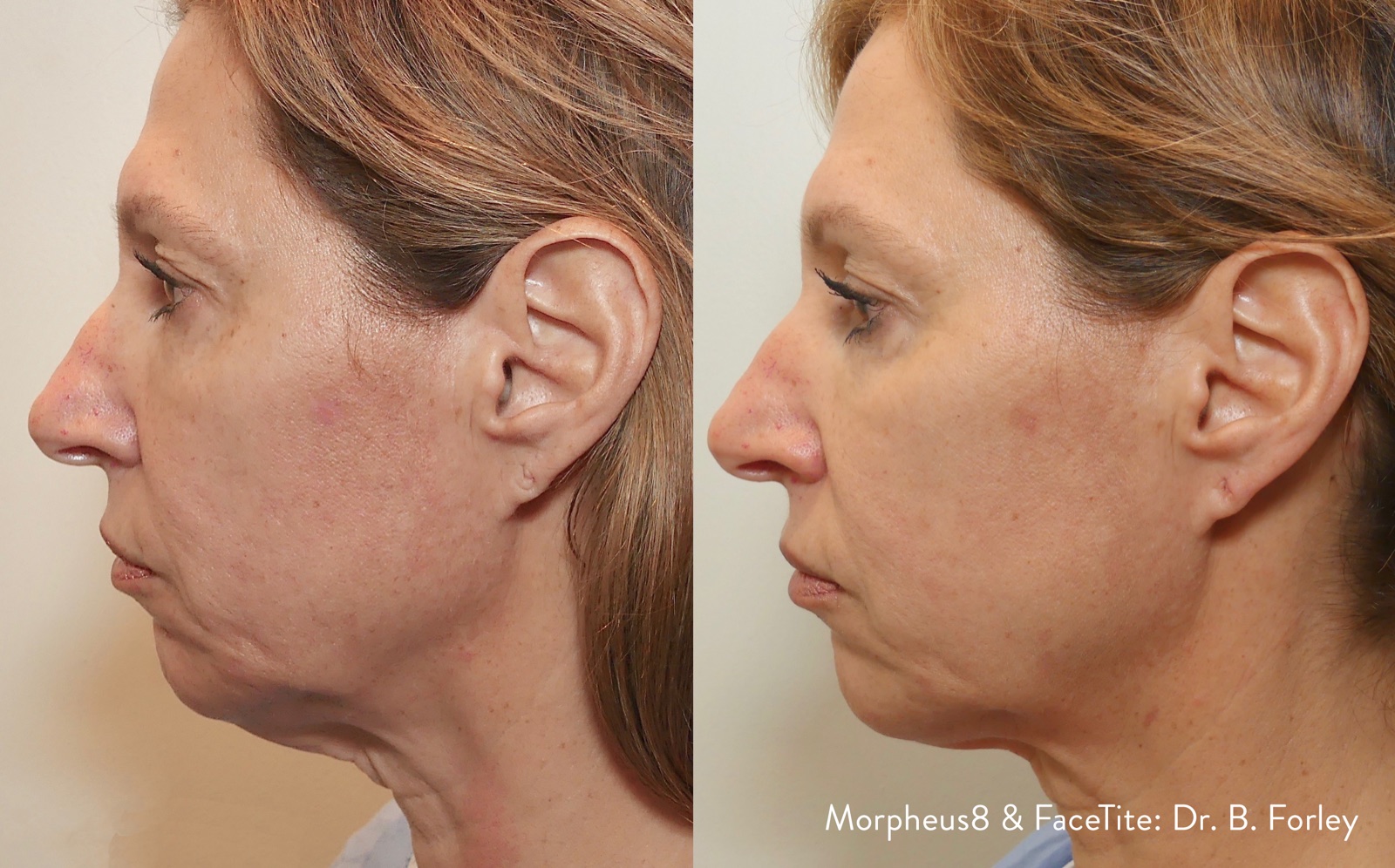
What Morpheus8 Face is best at
The face protocol is the most common Morpheus8 use case and the one most patients encounter first. It is designed for the layers of skin where facial aging actually happens — the dermis where collagen organizes and the subdermal fat where the face's underlying support changes shape over time.
Morpheus8 Face is best for:
- Early jowls and jawline softening — the most-requested concern, especially in patients 35-55.
- Neck crepiness and "tech neck" — horizontal lines and skin laxity along the front of the neck.
- Submental fullness — under-chin skin laxity, often treated alongside a Burst pattern.
- Acne scarring — particularly ice-pick and boxcar scars that surface treatments cannot reach.
- Décolleté texture and crepiness — frequently bundled with face + neck for the most-requested package.
- Pore size and surface refinement — secondary benefits of facial RF microneedling.
A typical face protocol is 3-5 sessions spaced 4-6 weeks apart, with results emerging at 3 months and peaking at 6. Pricing starts at $800 per session for face only, $1,200 for face + neck, and $1,600 for the full face + neck + décolleté package. The cumulative cost lands between $2,400 and $6,400 depending on area and session count.
What Morpheus8 Body is best at
The body protocol is a different conversation. It is built around larger surface areas, deeper tissue, and outcomes that lean toward contouring as much as tightening. A "Morpheus8 Body" session is treating a single anatomical zone per session — abdomen, flanks, thighs, arms, knees, or buttocks — at a depth that the face tip cannot reach.
Morpheus8 Body is best for:
- Post-pregnancy abdominal laxity — loose skin and stretch marks after baby or significant weight change.
- Crepey upper-arm skin — the "bra-line" and inner-arm laxity that does not respond to topicals.
- Inner-thigh and knee laxity — frequently requested by patients in their 40s and 50s.
- Cellulite texture — modest improvement through dermal remodeling, not fat reduction.
- Stretch marks — particularly on the abdomen, hips, and thighs.
Soothe IV pricing for Morpheus8 Body starts at $900 per session per zone, with a typical 3-5 session plan landing between $2,700 and $4,500. The body protocol is not a fat-loss treatment — it remodels collagen and tightens the dermal and subdermal layers. Patients looking for pure fat reduction in the absence of laxity are typically referred to a different category of treatment.
Who is a candidate for each
The right protocol depends less on age than on the specific concern and skin condition. A few patterns emerge across the patients we treat.
Face candidates typically present in three broad windows. Patients in their 30s often want early-stage tightening, pore refinement, and acne-scar improvement before laxity becomes pronounced. Patients in their 40s tend to want jawline definition and submental tightening — the most-requested concerns in this age band. Patients in their 50s and early 60s usually want a non-surgical alternative to the conversation about a facelift, often paired with neurotoxin maintenance and Forma RF tightening sessions in between.
Body candidates divide more cleanly by life event than by age. The largest cohort is post-pregnancy patients seeking abdominal skin remodeling, often 12-18 months after delivery once breastfeeding has concluded. The second-largest is post-weight-loss patients — particularly those who have lost 20+ pounds and have residual laxity on the abdomen, arms, or inner thighs. A third group is athletic patients in their 40s and 50s who have maintained their physique but lost dermal density in specific zones (knees, upper arms) that diet and exercise cannot recover.
Across both protocols, candidacy excludes active acne flares, pregnancy, recent isotretinoin (within 6 months), uncontrolled diabetes, and certain autoimmune conditions. The telehealth consult screens for all of these before a session is scheduled.
Recovery is different too
Face and body recoveries look different because the depth and surface area are different. The face is visible 100% of the time, so recovery is partly a question of social calendar. The body is usually clothed, so the timeline is dominated by what activity feels comfortable, not what looks acceptable.
| Recovery Window | Morpheus8 Face | Morpheus8 Body |
|---|---|---|
| First 24 hours | Sunburn-like flush, mild swelling, pinpoint marks visible. | Tender, warm, mild swelling; not visibly red under clothing. |
| Day 2-3 | Faint flush; makeup possible by hour 48. | Still tender; loose clothing more comfortable than tight waistbands. |
| Day 4-7 | Looking normal; collagen remodeling underway internally. | Tenderness resolving; light workouts back on the table. |
| Weeks 2-12 | Tightening builds gradually; peak at 3-6 months. | Skin tightening and texture changes build over 3-6 months. |
For body treatments, the most common limitations are tight clothing and high-impact exercise in the first 3-5 days. For face treatments, the limitations are makeup timing (typically OK by 48 hours), sun exposure (7-10 days minimum), and active skincare like retinoids (pause for 5-7 days).
Treating both face and body?
The right schedule matters more than the right tip. Our $50 telehealth consult builds a plan that sequences face and body sessions so each area gets a clean recovery window. The consult fee is credited to your first treatment.
Combining face and body in one plan
Many patients want to address both — a tightening jawline and a softer post-pregnancy abdomen, or facial collagen rebuilding alongside inner-arm crepiness. This is a reasonable plan, but it should be sequenced thoughtfully rather than stacked.
The general framework: a face area and a body area can be treated in parallel cycles if your provider spaces them at least 2-3 weeks apart and your skin tolerated the first session well. Some patients alternate — face in odd months, body in even months — so the calendar runs cleanly for 6 months and each area completes 3-5 sessions without overlapping inflammation.
What providers generally avoid is treating face and body in the same session. The total surface area is large, the numbing window stretches past 60 minutes, and the patient's inflammatory load is higher than necessary. Splitting the day across both areas also doubles the chair time and the recovery friction.
How sessions are scheduled when you're doing both
If you are committing to a 6-month plan that includes both face and body, the typical Soothe IV schedule looks like this:
- Month 1, Week 1: Face session 1 (in-home, 90 minutes total including numbing).
- Month 1, Week 3: Body session 1, separate zone (in-home, 60-90 minutes per zone).
- Month 2: Face session 2 mid-month, body session 2 late-month.
- Months 3-5: Continue alternating, with the same RN for continuity.
- Month 6+: Assess results, plan maintenance, optionally add Forma or Lumecca Peak for specific concerns.
For most patients in Newport Beach, Irvine, Costa Mesa, and Laguna Beach, this cadence fits cleanly around a normal work and social schedule. The mobile delivery model — sessions at your home rather than at a clinic — makes the calendar far easier to maintain, especially for face sessions where you would otherwise drive home flushed.
Whatever combination you are considering, the planning should happen at the consult. Adrienne Perales, RN performs both face and body protocols and works with Ian K. Tseng, MD to set the sequence, depth, and spacing for your specific concerns. The right schedule is a clinical decision, not a booking convenience.